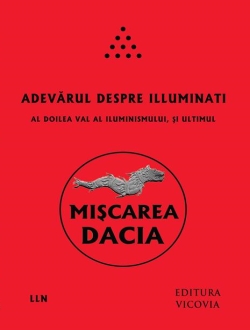

 Vă invit să vă alăturaţi grupului Facebook Mişcarea DACIA, ce-şi propune un alt fel de a face politică!
Citiţi partea introductivă şi proiectul de Program, iar dacă vă place, veniţi cu noi !
O puteţi face clicând alături imaginea, sau acest link
Cioran
Oamenii sănătoși, normali, mediocri nu pot experimenta nici agonie, nici moarte. Trăiesc ca și cum viața ar avea un caracter definitiv. Este o parte integrantă a echilibrului superficial al oamenilor normali pentru a lua viața independent de moarte și a considera moartea ca o realitate care transcende viața. De aceea, ei percep moartea ca venind din afară, nu ca o fatalitate interioară a vieții în sine. Una dintre cele mai mari amăgiri ale omului obișnuit este să uiți că viața este prizonierul morții. Revelațiile metafizice încep numai atunci când echilibrul superficial al unuia începe să se dezlănțuie și o luptă dureroasă este înlocuită de spontaneitatea naivă. Presimțirea morții este atât de rară la oamenii obișnuiți, încât practic se poate spune că nu există. Faptul că presimţirea morții apare numai atunci când viața este zgâlţăitătă
din temeliile sale, dovedește dincolo de îndoială, imanența morții în viață. O perspectivă asupra acestor adâncimi ne arată cât de iluzorie este credința în integritatea vieții și cât de bine a întemeiat credința într-un substrat metafizic al demonismului.
Extras din On The Heights of Dispair de E. M. Cioran

Healthy, normal, mediocre people cannot experience either agony or death. They live as if life had a definitive character. It is an integral part of normal people’s superficial equilibrium to take life as absolutely independent from death and to objectify death as a reality transcending life. That’s why they perceive death as coming from the outside, not as an inner fatality of life itself. One of the greatest delusions of the average man is to forget that life is death’s prisoner. Metaphysical revelations begin only when one’s superficial equilibrium starts to totter and a painful struggle is substituted for naive spontaneity. The premonition of death is so rare in average people that one can practically say that it does not exist. The fact that the presentiment of death appears only when life is shaken to its foundations proves beyond doubt the immanence of death in life. An insight into these depths shows us how illusory is the belief in life’s integrity and how well founded the belief in a metaphysical substratum of demonism.
Excerpt from On The Heights of Despair by E. M. Cioran
Artwork by Eric Lacombe
The Historical Illuminati

The Historical Illuminati
In contemporary mythology, the Illuminati have been branded as the puppetmasters who stand behind the establishment, pulling the strings, orchestrating the enslavement of the people of the world. The opposite is true. The Illuminati have always led the resistance against the tyrants. On occasions, they have come tantalisingly close to success, but mostly they have endured catastrophic defeats. They have tried to infiltrate the establishment, tried Trojan Horse strategies, guerrilla tactics and popular uprisings, tried to win the intellectual and religious debate, tried to subvert and undermine the establishment. Most attempts have ended in disaster, with the establishment unmolested and more powerful than ever. But it is never acceptable to surrender or abandon the struggle.
Too many people retreat into their micro-worlds of petty comforts where they pose no threat to the establishment, and that’s exactly what the establishment desire – our compliance and obedience, our refusal to stand up to them. The game of the establishment is nothing new. It was explicitly set out in Machiavelli’s The Prince, which baldly states the unscrupulous principles of how those with power should hold onto it. Lying, cheating, brutality, cruelty, pitilessness, inspiring fear and terror, breaking solemn oaths, hypocrisy, greed, bribery and corruption, extermination of rivals, making pacts with your enemies only to break them when it suits you, are all advocated as necessary tools. This behaviour is still on display every day from every government on earth.
The Illuminati have had a number of guises in the public arena, have formed many alliances and have founded many groups that they have used for particular purposes in the ongoing struggle against tyranny. But the objective has always been the same – to destroy the Old World Order, the network of powerful dynastic families and privileged elites who have engineered earthly wealth and power for themselves, and to hell with everyone else. The Old World Order were the masters thousands of years ago and they are the masters now. They assiduously follow the advice of Machiavelli, but they didn’t need him to tell them the rules of the game. Machiavelli merely described what they had been doing for millennia.
Through every disaster, the OWO endure. Has the latest financial disaster dented their power? Not in the slightest. Nothing has changed. People talk about doing this and doing that against them, but in reality nothing happens. The system is locked down. It is impossible to change it within its own parameters. It is designed to be resistant to anything other than revolution, but there are few revolutionaries left in the world. The Old World Order’s system is close to perfection. It is a matrix of absolute control. Only a small number of people (some 6,000) run the world, yet they are backed up by all the agencies of oppression: the police, the military, the intelligence services, the law (designed, ultimately, to protect the assets of the rich). The billions of ordinary people in the world, who could sweep away tyranny in an instant, are too scared to fight back. They are cowed and docile. They are the “last men” to whom Nietzsche referred so derisively.
The Illuminati’s mission, in one sense, is to help last men regain their dignity, to throw off their chains and stand up straight for once. How is that to be done? By putting people in touch with their higher selves. When the divine spark is released in an individual, he no longer tolerates the condition of slavery, no longer mires himself in trivia and meaningless pursuits to pass the time. Above all things, the Old World Order fear what would happen if their manufactured mastery were challenged by legions of those who had found their higher selves and lost their fear. As will be shown below, many brave groups have resisted the OWO. The vastly more numerous forces of the OWO crushed them, but it will not always be so. “The darkest hour is just before the dawn.”
Excerpted, page 300
© The Illuminati’s Secret Religion
Artwork by Raceanu Mihai
The Holographic Principle

The Holographic Principle
“The holographic principle is a property of quantum gravity and string theories which states that the description of a volume of space can be thought of as encoded on a boundary to the region—preferably a light-like boundary like a gravitational horizon. String theory admits a lower dimensional description in which gravity emerges from it in what would now be called a holographic way. In a larger and more speculative sense, the theory suggests that the entire universe can be seen as a two-dimensional information structure ‘painted’ on the cosmological horizon, such that the three dimensions we observe are only an effective description at macroscopic scales and at low energies. Cosmological holography has not been made mathematically precise, partly because the cosmological horizon has a finite area and grows with time. The holographic principle was inspired by black hole thermodynamics, which implies that the maximal entropy in any region scales with the radius squared, and not cubed as might be expected. In the caseof a black hole, the insight was that the informational content of all the objects which have fallen into the hole could be entirely contained in surface fluctuations of the event horizon. The holographic principle resolves the black hole information paradox within the framework of string theory.” – Wikipedia
Mythopoeic thought: a hypothetical stage of human thought prior to modern thought. Humanity did not think in terms of generalizations and impersonal laws. Instead, humans regarded each event as an act of will by some personal being. This is “Mythos” rather than “Logos” thinking, and events are explained by way of narratives accounting for the actions of spirits and gods. Abrahamism is mythopoeic, the narrative being entirely concerned with the Will of God, and of humans cooperating with, or defying, God’s will. God causes the “Flood” because he is angry, not because of an earthquake and subsequent tsunami (i.e. a wholly natural event).
The “bicameral” mental model proposed by Julian Jaynes asserts that before the rise of modern consciousness, human beings experienced auditory hallucinations in which the gods and spirits spoke to them (a condition not unlike schizophrenia). Naturally, these provided a mythopoeic, narratised version of reality, which remains very popular to this day since most people understand the world through stories rather than hard, logical analysis.
It has been claimed that the ancient Egyptians and Mesopotamians lived in a wholly mythopoeic world – and the same may be said of the Hebrews, Christians and Muslims. The latter three religions replaced polytheistic Mythos with a monotheistic Mythos, but all the Mythos rules and mentality remained in place.
The ancient Greeks were the first to offer a Logos rather than Mythos way forward. The pre-Socratic philosophers treated “God” as a kind of impersonal, abstract cosmic mind (a deist rather than theist approach i.e. God remote from us rather than personally interested in us). In time, this evolved into the scientific materialist view where God was replaced by a set of natural, inflexible laws of cause and effect.
For these intellectual Greeks, each event was seen not as an act of God’s will (contrast Muslims who, even today, think that Allah personally directs their RPG grenades i.e. it’s his will whether they hit their target or not, and has nothing to do with the laws of physics).
Logos thinking kills Mythopoeic thinking. Logos thinking is the basis of authentic consciousness, but, sadly, most people prefer the Mythos worldview. They are not truly conscious and in charge of their own destiny but instead remain strongly bicameral, believing that some sort of divine will is really in charge, to which they think they can pray to change the course of their lives. The whole concept of prayer is bicameral. It implies that a person can enter into direct communication with the gods, and even with the Creator of the Universe, by uttering a few ritual incantations (like magic!) and then pleading with the Creator for a few personal favours not to be conferred on others. Prayer is conceived as a kind of direct conversation between a human being and his Creator. It is thus exactly the same as bicameralism whereby a person imagines he hears the voice of God in his own head, giving him commands.
In the Logos view, this is insane. It’s not an exaggeration to say that most of humanity remains bicameral, prone to “magic” Mythopoeic thinking, and that they cannot be considered fully conscious and rational.
Mythos human beings vastly outnumber Logos human beings, which is why our world is the way it is. It’s a place of stories, illusions, delusions, hallucinations, emotions and sensations rather than reason, logic, science, mathematics and philosophy.
Stupid, emotional people always block rational progress. How on earth can anyone rationally deal with billions of Muslims, Christians and Jews who continue to believe in scientifically disproven fantasies? How can the planet possibly become enlightened when such people exist?
Vitalism: the belief that the functions of a living organism are due to a vital principle distinct from biochemical reactions; that the processes of life are not explicable by the laws of physics and chemistry alone; that life is self-determining. Vitalism invokes a vital principle: the “vital spark” or “élan vital” (sometimes equated with the soul or spirit).
In medicine, vitalism proposes that disease results from imbalances in the vital energies that distinguish living from non-living matter. In the West, in ancient times, these vital forces were associated with the four temperaments and humours (“sanguine”, “choleric”, “melancholic” and “phlegmatic”); in the East forces such as qi and prana are held of central importance and must be perfectly balanced. Any blockages must be removed. Vitalism in medicine is concerned with living energies while modern Western medicine is materialistic, reductionist and mechanistic. Western medicine sees a patient as a broken-down car in need of repair by a mechanic; vitalist medicine is much more concerned with mental energy, with the patient as a living organism not reducible to “spare parts”.
Nondualism: the Eastern belief that things which appear distinct are in fact not separate but belong to an underlying unity; thus it has much in common with Western monism. While monism holds that all phenomena actually belong to the same substance, nondualism asserts that different phenomena are inseparable or flowing into each other, and there is no hard demarcation line between them. Nevertheless, they are not the same as monism would contend they ultimately are. Zen Buddhism is nondualist while Advaita Hinduism is monist (because it contends that all phenomena are really Brahman).
Excerpt from The God Game
Mike Hockney
Autodidact

Hyperian History Of The World (18th Century, Part 2)
Hyperian History Of The World (18th Century, Part 2)
Philosophically speaking, 17th century rationalism had flourished in continental Europe, beginning with Descartes and culminating with Leibniz going into the 18th century. In parallel to this course, there had also been a strain of philosophy running in Britain which opposed rationalism. This was empiricism.
If the continental rationalists followed the example of Plato, then the British empiricists followed the example of Aristotle. Beginning with Francis Bacon, the empiricists were ‘outward’ looking philosophers, much more like scientists, who looked out into the physical world around them and sought to explain it based solely on their experiences of it.
Towards the end of the 17th Century, it was John Locke who, disregarding rationalism completely, said that humans can only have knowledge that is ‘a posteriori’ i.e. based upon experience. He described the human mind as a ‘tabula rasa’, a blank slate completely empty at our birth but then becoming populated with ideas based only on the experiences we have of the world.
Locke’s empiricism was materialist, philosophically accompanying the empiricist, materialist science of Newton. Going into the 18th century, Irish philosopher and Anglican bishop George Berkeley feared that Locke’s philosophy would lead to atheism and so proposed an alternative version of empiricism which was idealist rather than materialist. According to Berkeley, matter only exists when it is being perceived by an observer. Without observation there is no matter at all. So what stops the room ceasing to exist when we exit it? Conveniently, Berkeley said that god was constantly observing everything in the universe, thereby stopping things from ceasing to exist when we stop observing.
But the most extreme empiricist of the 18th century was Scottish philosopher David Hume. With Hume empiricism descends into absolute skepticism. Given that, according to Hume, all our knowledge derives from our experiences, from what we observe, it becomes impossible to provide any rational explanation of anything, as reason supposes causation and, as Hume insists, causation cannot be observed, therefore we can never really be certain of anything. Hume’s philosophy leads towards complete uncertainty about anything whatsoever.
Of course, another way of looking at Hume’s philosophy is to say that it proves that empiricism is clearly a false ideology which will never provide any certain knowledge about the universe. Unfortunately, Hume did not see it this way, concluding rather that no philosophy could provide any certain knowledge about the universe, as he had presupposed that empiricism was the only relevant philosophy.
Hume’s philosophy was the culmination of British empiricism the way that Leibniz’s was the culmination of continental rationalism. However, the next great continental philosopher, the German Immanuel Kant, was far more influenced by Hume than by Leibniz. Inspired by a desire to resolve Hume’s skeptical conclusions, Kant attempted to sculpt a grand system which would synthesise the two parallel strains of philosophy.
Whereas Descartes divided everything into mind and matter, Kant divided everything into the phenomenal and the noumenal. The phenomenal realm corresponded to the physical realm of matter, the realm that we experience with our senses, that we can see, hear, touch and feel. The noumenal realm corresponded to realm of mind, like Plato’s realm of the perfect Forms, the true realm of things as they really are in themselves. However, in line with empiricism, Kant suggested that we can only ever experience the phenomenal realm and never experience the noumenal realm, as our minds only interpret the noumenal realm and it is this interpretation that creates the phenomenal realm that we experience.
Kant had far more rigorously defined all of these issues philosophically but had still reached the conclusion that we can never know how the universe actually is. This was due to his ignoring of the mathematical side of things. Kant’s attempt was valiant, yet he ought to have ignored British empiricism and focused on Leibniz’s rationalism and its need for mathematical rigour. Ingenious though his philosophy was, Kant’s failure to apply mathematics to it is what resulted in his conclusion that we can never truly know the universe.
Nonetheless, Kant became one of the most influential philosophers of the modern age and his ideas, along with those of the British empiricists, would influence the science which had begun with Newton. As such, science became completely based on empiricism and materialism, Newton was a hero, as were Kant and Hume, with Descartes and Spinoza being reduced to academic curiosities and Leibniz all but forgotten.
Nonetheless, this age of enlightenment was clearly an improvement on the preceding dark age of christian domination. Despite ignoring the wisdom of the great rationalists, the world of the 18th century seemed to be brightening and great wonders were still to come, both artistically and politically.